
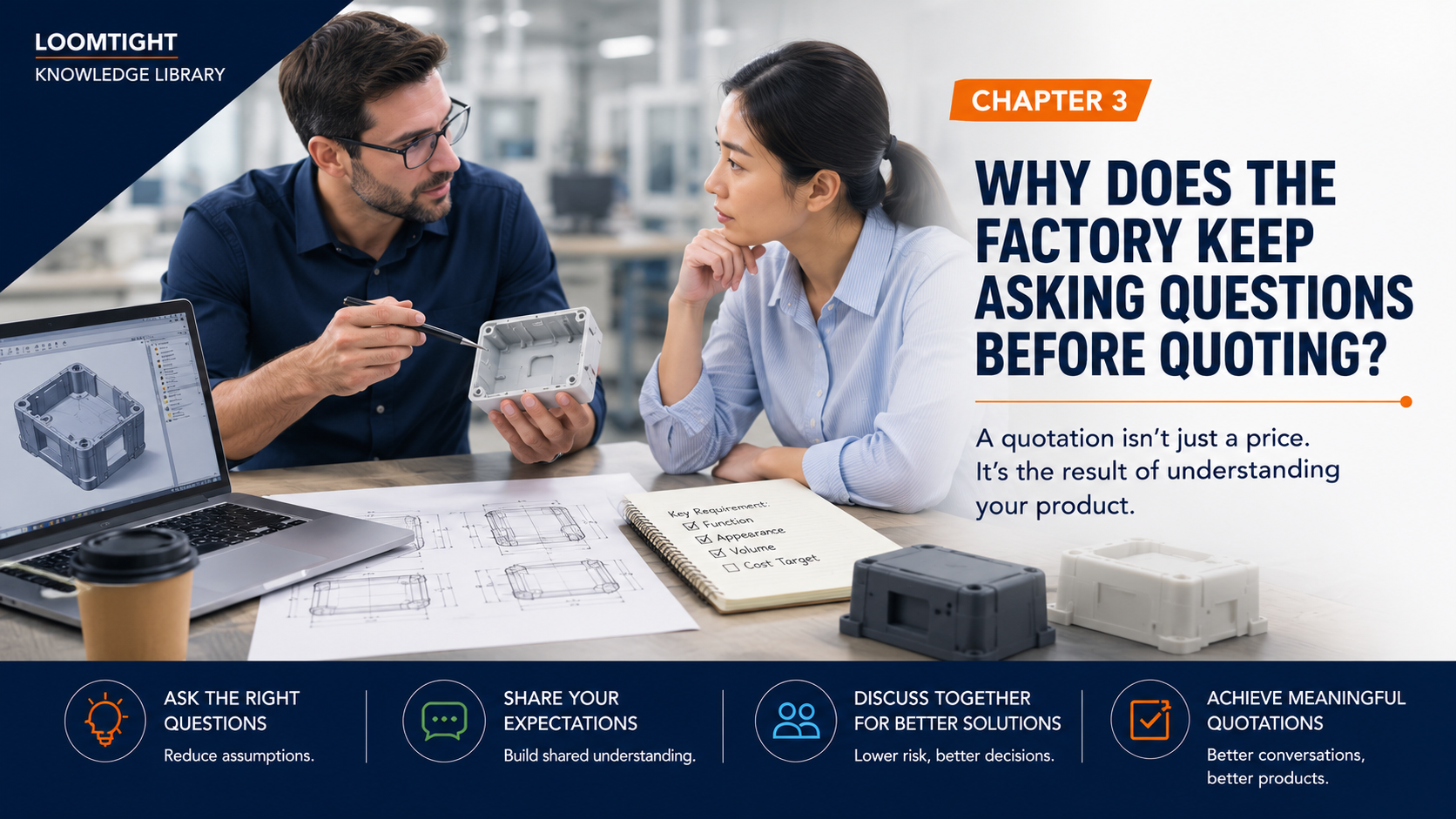
A quotation isn’t just a price. It’s the result of understanding your product.
“Can you give me a quotation?”
“Of course.”
“What information do you need?”
“That depends.”
“On what?”
“On what you’re really trying to build.”
For many first-time product developers, this conversation is surprisingly familiar.
You’ve spent weeks thinking about your product idea. You’ve collected reference samples, made sketches, and perhaps even discussed your concept with friends or potential customers. After reading the previous chapter, you’ve prepared yourself for the first conversation with a manufacturer.
Naturally, you expect the next step to be simple.
Send the information.
Receive a quotation.
Compare prices.
Move forward.
Instead, something unexpected happens.
The manufacturer begins asking another series of questions.
Sometimes there are only a handful.
Sometimes there are dozens.
At first, this can feel frustrating.
“Didn’t I already explain what I wanted?”
The answer is yes.
You explained your product idea.
Now the manufacturer is trying to understand the product well enough to manufacture it.
Those are two very different stages of the conversation.
A quotation isn’t created from an idea.
It is created from a product definition.
Every question the manufacturer asks is helping transform your expectations into something that can be designed, manufactured and accurately priced.
Once you understand this, those questions no longer feel like obstacles.
They become part of the product development process itself.
Every Question Has a Purpose
Many people assume manufacturers ask detailed questions simply because they are being cautious.
Others believe they are trying to protect themselves from future disputes.
While both may be true in some situations, they are not the primary reason.
Experienced manufacturers ask questions because every answer reduces uncertainty.
A quotation is never just a number.
It is a commercial proposal built upon hundreds of assumptions.
Every assumption introduces risk.
Every answer removes one of those assumptions.
The clearer your product becomes, the more meaningful the quotation becomes.
That’s why experienced manufacturers rarely rush to provide a price.
They first work towards a shared understanding of what they are actually being asked to build.
Once that understanding exists, preparing a quotation becomes much easier—and far more reliable.
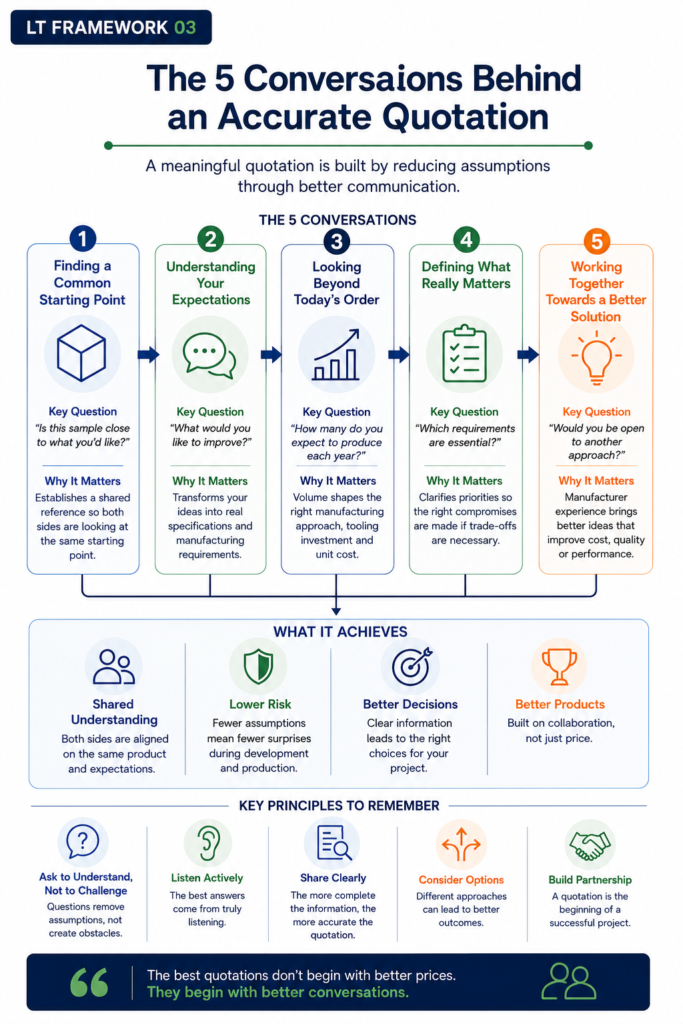
Finding a Common Starting Point
Manufacturer
“Is this sample close to what you’d like to produce?”
Client
“Yes, probably about ninety percent.”
At first glance, this appears to be a simple question.
In reality, it establishes the foundation for the entire project.
The manufacturer isn’t asking whether the product should be copied exactly.
They’re trying to understand how closely the sample represents your expectations.
If the sample is already very close to your vision, the discussion can focus on the remaining differences.
If the sample only represents a general direction, the manufacturer immediately knows that much more exploration will be needed before preparing a quotation.
A good reference sample does something remarkably valuable.
It removes uncertainty before anyone starts discussing technical details.
Instead of imagining the product independently, both sides are now looking at the same object.
That shared reference dramatically improves communication.
The closer your reference sample reflects what you hope to achieve, the easier it becomes for everyone to discuss improvements rather than trying to imagine the entire product from words alone.
The quotation hasn’t started yet.
But the quality of the future quotation has already improved.
Understanding Your Expectations
The discussion continues.
Manufacturer
“What would you like to improve?”
Client
“I’d like it to feel more premium.”
Again, a perfectly reasonable answer.
But from the manufacturer’s perspective, it immediately creates another question.
What does premium actually mean?
Does it mean:
- a heavier product?
- a softer touch?
- a more elegant appearance?
- better decoration?
- higher durability?
- improved user experience?
Different people imagine different things when they use the same word.
This is one of the most common communication gaps in product development.
Customers naturally describe products in terms of expectations.
Manufacturers naturally think in terms of solutions.
Neither perspective is wrong.
They’re simply speaking different professional languages.
This is why experienced manufacturers continue asking questions rather than making assumptions.
Their goal isn’t to challenge your idea.
Their goal is to translate your expectations into engineering decisions.
Sometimes the solution involves a different material.
Sometimes a different manufacturing process.
Sometimes a different surface finish.
Sometimes a completely different design approach.
The customer doesn’t need to know those technical answers.
That’s precisely why they’re talking to an experienced manufacturer.
The manufacturer’s expertise isn’t simply making products.
It’s helping transform expectations into manufacturable solutions.
LoomTight Observation
Customers describe expectations.
Manufacturers define specifications.
Successful products require both.
Looking Beyond Today’s Order
The discussion moves on.
Manufacturer
“How many do you expect to produce each year?”
Client
“I’m not sure yet. Why does that matter?”
It’s a question many first-time product developers ask.
After all, you’re requesting a quotation for a product—not placing a production order.
Surely the manufacturer can calculate the price first and worry about quantities later.
In reality, production volume influences almost every manufacturing decision.
A product expected to sell a few thousand units each year may be designed and manufactured very differently from one expected to sell several million.
The anticipated volume affects tooling investment, production efficiency, manufacturing methods and, ultimately, the unit cost.
In some cases, it may even influence how the product itself is designed.
This is why experienced manufacturers ask about production volume long before discussing prices.
They’re not simply estimating how many products you’ll buy.
They’re trying to recommend the most appropriate manufacturing solution for your business.
Sometimes that recommendation may involve investing more in tooling to reduce long-term production costs.
Sometimes it may be the opposite.
If demand is still uncertain, a simpler manufacturing approach may reduce financial risk during the product’s early stages.
The quotation isn’t just about today’s order.
It’s about supporting the commercial success of your product over time.
Defining What Really Matters
As the discussion continues, the questions often become less technical and more strategic.
Manufacturer
“If we need to make compromises later, which features are absolutely essential?”
The client pauses.
This question often surprises people.
Until now, the conversation has focused on possibilities.
Now the manufacturer wants to understand priorities.
Very few products achieve every desirable feature without limitations.
Budgets exist.
Production constraints exist.
Time constraints exist.
Good product development isn’t about avoiding compromises.
It’s about making the right compromises.
Perhaps appearance is the highest priority.
Perhaps durability matters more than aesthetics.
Perhaps launching on time is more important than adding another feature.
Every project has priorities.
Understanding them early helps everyone make better decisions throughout development.
Without clear priorities, every design change becomes difficult because no one knows which objective should take precedence.
One of the most valuable things a client can do is explain not only what they want, but what matters most.
That single conversation often saves countless hours of discussion later.
Working Together Towards a Better Solution
By now, both sides have developed a much clearer understanding of the product.
Then the manufacturer asks one final question.
Manufacturer
“Would you be open to another approach?”
Client
“Of course. What do you recommend?”
This is often the moment when the conversation changes.
Until now, the manufacturer has mainly been gathering information.
Now they’re beginning to contribute experience.
Perhaps another material would provide the same appearance at a lower cost.
Perhaps a different production process would improve efficiency.
Perhaps a small design adjustment would simplify tooling while maintaining the same functionality.
Perhaps two components could become one.
Perhaps an assembly step could be eliminated altogether.
None of these suggestions change the client’s objective.
They simply represent different ways of achieving it.
This is where experienced manufacturers create the greatest value.
They aren’t just producing what the customer asks for.
They’re helping the customer achieve the desired outcome more effectively.
Sometimes the best solution isn’t the one the client originally imagined.
It’s the one both sides discover together.
The Real Purpose Behind Every Question
Looking back, the conversation wasn’t really about answering questions.
It was about reducing uncertainty.
Every question removed another assumption.
Every answer improved the shared understanding of the product.
Every discussion reduced the risk of misunderstanding during design, tooling and production.
By the time the quotation is finally prepared, both sides should have a much clearer picture of what is actually being built.
That’s why experienced manufacturers rarely begin with a price.
They begin with understanding.
Ironically, the fastest way to receive a meaningful quotation is often to spend a little more time talking before anyone starts calculating costs.
From Experience
Over the years, I’ve participated in hundreds of quotation discussions with product owners, procurement teams and manufacturers.
Looking back, one observation stands out.
The projects that progressed most smoothly were rarely those that started with the lowest quotation.
They were the ones that started with the clearest conversations.
Successful clients didn’t necessarily know more about manufacturing.
They simply prepared better.
They brought meaningful reference samples.
They explained what they liked.
They explained what they wanted to improve.
They were honest about what they didn’t know.
And perhaps most importantly, they were willing to listen when manufacturers suggested alternative approaches.
The manufacturers who delivered the best results behaved in much the same way.
They didn’t rush to provide a price.
They asked thoughtful questions.
They challenged assumptions respectfully.
They shared their experience openly.
Their objective wasn’t simply to produce what the customer requested.
It was to help the customer develop the best possible product.
When both sides approach the discussion with that mindset, something interesting happens.
The quotation becomes more than a commercial document.
It becomes the foundation of a successful development project.
Before You Decide
Before requesting a quotation, ask yourself:
- Have I clearly explained what I’m trying to achieve?
- Have I shared a reference sample, sketch or prototype whenever possible?
- Have I identified which features are essential and where I’m open to suggestions?
- Have I provided enough information for the manufacturer to understand my expectations?
- Am I asking for the lowest quotation, or the most suitable solution?
- Am I choosing a manufacturer simply to make my product, or to help me develop it?
The answers to these questions often determine the quality of the quotation long before the first number appears on the page.
Looking Ahead
By now, you’ve probably realised that preparing an accurate quotation involves much more than calculating manufacturing costs.
Every quotation reflects a series of decisions.
Some relate to the product itself.
Others relate to your business objectives.
One of the earliest—and most influential—business decisions is something many first-time product developers haven’t fully considered yet.
How many products do you actually expect to produce?
At first glance, it sounds like a simple planning question.
In reality, expected production volume influences tooling investment, manufacturing methods, production efficiency, inventory strategy and ultimately the cost of every product you sell.
It’s one of the earliest decisions that can significantly affect both your manufacturing costs and your commercial success.
In the next chapter, we’ll explore why production volume is far more than a sales forecast—and why understanding it early can save both time and money throughout product development.
Final Thought
Many first-time founders believe the purpose of a quotation is to learn how much a factory will charge.
Experienced product developers see it differently.
A quotation is not simply a price.
It is evidence that both sides have reached a shared understanding of the product.
The more complete that understanding becomes, the more meaningful the quotation becomes.
Good manufacturers don’t ask questions because they’re trying to make the process more complicated.
They ask questions because every answer removes uncertainty.
Every discussion reduces risk.
Every clarification improves the product.
In the end, the most valuable outcome of your first quotation meeting isn’t the number at the bottom of the page.
It’s the confidence that both you and your manufacturing partner are working towards the same product, with the same expectations and the same understanding.
Because the best quotations don’t begin with better prices.
They begin with better conversations.