
The first conversation is more important than most people realize.
Introduction
“I have a product idea, but I don’t know what to tell the factory.”
If you’ve never developed a product before, this thought is completely normal.
Perhaps you’ve found a product online that inspires you. Perhaps you’ve bought several similar products and noticed things you like —and things you would improve. Or perhaps your idea only exists as a sketch in a notebook.
At this stage, many founders hesitate to contact manufacturers because they believe they aren’t ready.
“I don’t have engineering drawings.”
“I don’t know what material should be used.”
“I don’t know the manufacturing process.”
“I don’t even know the right questions to ask.”
These concerns are understandable.
Fortunately, they are usually unnecessary.
One of the biggest misconceptions about product development is the belief that you must have everything figured out before speaking with a manufacturer.
In reality, experienced manufacturers rarely expect that.
What they expect is something much simpler.
A good starting point.
Every Product Begins Somewhere
There is no single “correct” way to begin a product development project.
Some clients arrive with detailed engineering drawings.
Others bring a hand-made prototype.
Many simply bring a product already available on the market.
Some bring nothing more than an idea.
All of these are valid starting points.
The purpose of the first conversation is not to finalise every specification.
Its purpose is to establish a shared understanding of what you’re trying to achieve.
That understanding will grow with every discussion.
The Question You’ll Probably Be Asked First
One of the first questions many manufacturers ask is surprisingly simple.
“Do you have a sample?”
Some first-time founders find this confusing.
“If I already had the product, why would I be developing a new one?”
The answer is that the sample isn’t expected to be the final product.
It is simply the fastest way to communicate your expectations.
A sample instantly tells an experienced manufacturer far more than most people realise.
The closer the sample represents what you hope to achieve, the easier it becomes for both sides to discuss improvements instead of trying to imagine the entire product from words alone.
Without saying a word, it can communicate:
- the overall appearance you’re aiming for,
- the approximate quality level you expect,
- the size and proportions,
- the user experience,
- the manufacturing complexity,
- and often even the market positioning of the product.
Most importantly, it creates a common point of reference.
Instead of discussing abstract ideas, both sides are looking at the same object.
That makes productive conversations much easier.
A Sample Isn’t Something to Copy
This is where many people misunderstand the role of a reference product.
You’re not asking the manufacturer to copy it.
You’re saying:
“This is the closest example of what I have in mind.”
Perhaps you like the shape but want a different closure.
Perhaps you like the quality but want to reduce the cost.
Perhaps you like the functionality but want a more premium appearance.
Perhaps you simply want to combine the best features from several existing products.
That’s perfectly normal.
In fact, many successful products begin exactly this way.
The sample isn’t the destination.
It’s the starting point for a conversation.
LoomTight Observation
A sample is not something to copy.
It is a common language between you and your manufacturer.
When You Don’t Have All the Answers
Many first-time product developers worry that they should already know every detail before contacting a manufacturer.
In reality, that is rarely the case.
During my career, I’ve seen projects begin in many different ways. Some clients arrived fully prepared. Others only had an idea and were looking for guidance.
Both approaches can lead to successful products.
The important thing is understanding what you already know—and being honest about what you don’t.
Every Project Starts Differently
There is no standard path into product development.
In practice, the first conversation usually falls into one of these situations.
Scenario 1 — “I Have a Product Similar to What I Want.”
This is probably the most common situation.
The client brings a product already available on the market and says,
“This is close to what I want.”
Perhaps they like the appearance but want a different colour.
Perhaps they want a stronger hinge.
Perhaps they need a larger capacity or a different closure.
The sample immediately establishes a common reference, allowing both sides to focus on the differences instead of trying to describe the entire product from scratch.
Scenario 2 — “I Have Several Samples.”
Sometimes no single product represents the client’s vision.
Instead they bring several.
One has the right appearance.
Another has the preferred functionality.
A third demonstrates the desired quality.
The manufacturer begins asking a simple question:
“Which parts of each sample would you like to combine?”
At this stage, the conversation is no longer about copying existing products.
It is about defining a new one.
Scenario 3 — “I Only Have an Idea.”
This situation is far more common than many people realise.
The client may only have:
- a simple sketch,
- a concept drawing,
- a rough prototype,
- or even just an explanation.
That is enough to begin.
An experienced manufacturer will usually guide the discussion by asking questions that gradually transform an idea into something more concrete.
Scenario 4 — “I’m Looking for Suggestions.”
This is perhaps the most interesting conversation of all.
Sometimes the client doesn’t know what solution is best.
They understand the market.
They understand their customers.
But they don’t yet understand the manufacturing possibilities.
They might say,
“This is what I’d like to achieve. What would you recommend?”
For an experienced manufacturer, this is not an unusual request.
In fact, many successful projects begin exactly this way.
The manufacturer may suggest:
- a different manufacturing process,
- a more suitable material,
- a simpler product structure,
- a different decoration method,
- a more cost-effective assembly,
- or an alternative design that achieves the same objective with lower risk.
These suggestions are not changing the client’s idea.
They are helping the client achieve the same objective more effectively.
Good Manufacturers Don’t Expect You to Know Everything
Many founders hesitate to contact manufacturers because they worry about asking “basic” questions.
That concern is understandable.
However, a good manufacturer rarely expects a first-time client to understand resin grades, tooling construction, surface finish standards, or production processes.
Those are the manufacturer’s expertise.
Your expertise is understanding your product, your market, and your customers.
The manufacturer’s expertise is translating your expectations into manufacturable solutions.
Successful projects happen when both sides contribute what they know best.
From Experience
Some of the most successful projects I’ve worked on didn’t begin with a complete specification.
They began with an honest conversation.
“This is the closest product we’ve found.”
“These are the things we like.”
“These are the things we’d like to improve.”
That was enough.
From there, every meeting added another piece to the puzzle.
A clearer product.
A better understanding.
Better decisions.
Eventually, a manufacturable solution.
Looking back, the quality of those early conversations often determined the success of the entire project.
Not because every answer was known on the first day.
But because both sides were working towards the same understanding.
LoomTight Observation
You don’t need all the answers before contacting a manufacturer.
You need enough information to begin the right conversation.
The Goal Isn’t to Have All the Answers
Your first meeting with a manufacturer isn’t a test.
You aren’t expected to understand resin grades, tooling construction, manufacturing processes or production techniques.
Those are the manufacturer’s expertise.
Your responsibility is different.
Your job is to understand your product well enough to explain what you’re trying to achieve.
The manufacturer’s job is to translate those expectations into practical manufacturing solutions.
The better you prepare for that conversation, the better advice you’ll receive.
Successful product development isn’t about one side having all the answers.
It’s about both sides working together to find the right answers.
Before You Decide
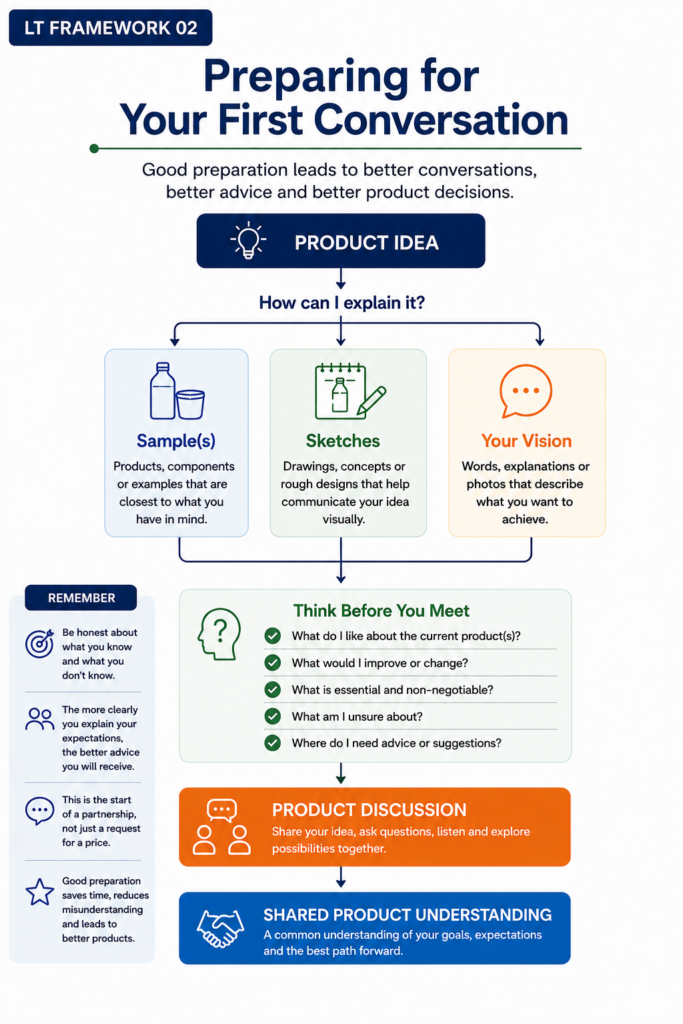
Before contacting a manufacturer, ask yourself:
- Do I have a sample, sketch, prototype, or clear description that represents my idea?
- Can I explain what I like—and what I would like to improve?
- Which decisions have I already made?
- Which decisions would I like professional advice on?
- Am I looking for someone to manufacture my idea, or someone to help develop it?
The answers don’t need to be perfect.
They simply need to provide a starting point for productive discussion.
Looking Ahead
By now, you’ve probably realised that preparing for your first meeting isn’t about knowing every technical detail.
It’s about giving the manufacturer enough information to understand your product idea and your expectations.
You’ve shared your samples, sketches or ideas.
You’ve explained what you like and what you’d like to improve.
Most people assume the next step is receiving a quotation.
Instead, experienced manufacturers usually begin asking another series of questions.
Not because they don’t understand your idea.
But because they are now transforming your expectations into a product that can be manufactured, evaluated and accurately quoted.
In the next chapter, we’ll explore why those questions matter, what manufacturers are really trying to understand, and how that conversation gradually becomes a product specification.