
Establishing Direction
Every successful project begins long before engineering drawings are complete.
Before selecting materials, requesting quotations, or discussing tooling, one fundamental question must first be answered:
Where is this project trying to go?
That question may sound surprisingly simple.
However, many development projects begin by discussing technical solutions before the commercial objectives have been clearly defined.
When the destination is unclear, even excellent engineering can take the project in the wrong direction.
The first three decisions establish the foundation for everything that follows.
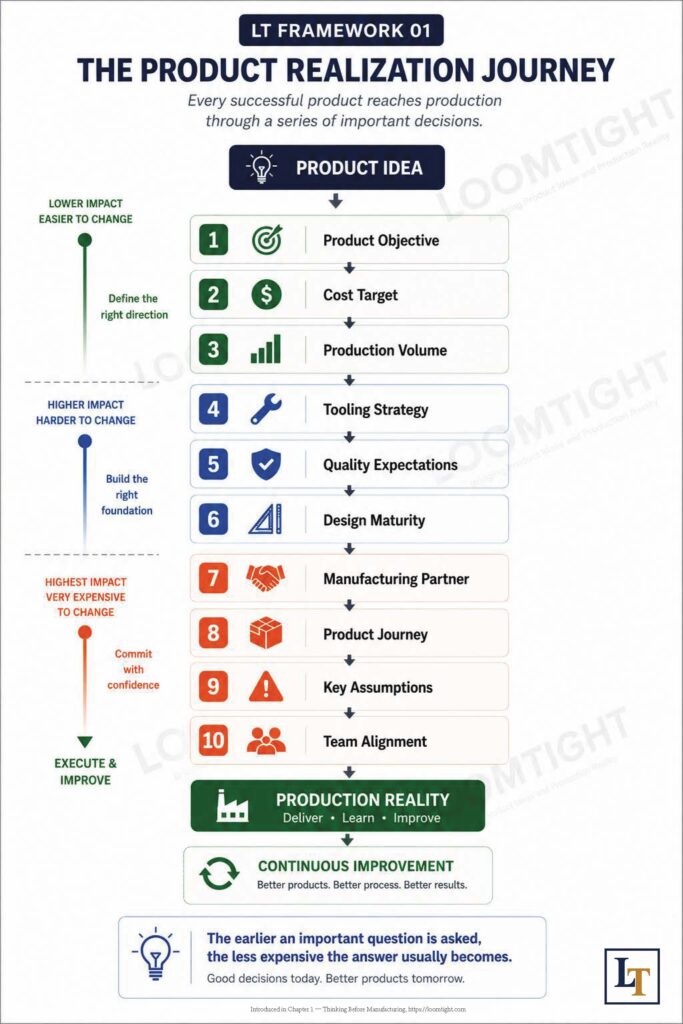
LT Framework 01
The Product Realization Journey
Every successful product reaches production through a series of important decisions.
The framework below provides an overview of those decisions before we explore each one individually.
Decision 1
What Problem Is This Product Really Solving?
Every product exists to solve a problem.
Sometimes that problem is practical.
Sometimes it improves convenience, appearance, safety or user experience.
Occasionally, the problem is simply reducing cost.
Whatever the objective, it should be understood before detailed engineering begins.
Without a clearly defined purpose, product development gradually becomes a collection of unrelated decisions rather than one coordinated effort.
Why This Decision Matters
Product objectives influence almost every decision that follows.
Material selection.
Manufacturing methods.
Quality expectations.
Packaging.
Production cost.
Supplier selection.
These are not independent decisions.
They should all support the same objective.
Instead of asking:
“What features should we add?”
Start by asking:
“What does success look like?”
Once that answer is clear, many later decisions become much easier.
From Experience
Projects rarely struggle because people are working hard.
They struggle because people are working toward different priorities.
A designer may focus on appearance.
Engineering may focus on performance.
Purchasing may focus on cost.
Manufacturing may focus on production stability.
Sales may focus on launch timing.
Each objective is reasonable.
The challenge is ensuring they support the same destination.
Before You Decide
Before detailed development begins:
- What problem is this product solving?
- Which characteristics are essential?
- Which features are desirable but not critical?
- If compromises become necessary, what should never be sacrificed?
Every important decision made later should still support these answers.
Decision 2
Have We Defined the Right Manufacturing Cost Target?
Once the project’s objective is clear, the next question naturally follows.
Can the product be manufactured at a cost that supports those objectives?
Notice the wording.
Not:
“How much will it cost?”
But:
“How much should it cost?”
The market often determines the selling price before production begins.
Manufacturing cost must support that commercial reality.
Why This Decision Matters
A manufacturing cost target is not simply a financial objective.
It is one of the product’s design requirements.
Without one, many engineering decisions become difficult to evaluate.
Should a higher-grade material be used?
Should automation be introduced?
Should tooling investment increase to reduce future production cost?
Should cosmetic features be simplified?
Every answer depends on understanding the commercial objectives established at the beginning of the project.
In Practice
Many projects exceed budget long before production starts.
Not because suppliers charged too much.
But because the target cost was never clearly established.
Engineering optimized performance.
Manufacturing optimized efficiency.
Meanwhile, the market had already decided what customers were willing to pay.
By the time those realities met, many affordable options had already disappeared.
Before You Decide
Before development moves further:
- Has a realistic manufacturing cost target been established?
- Is it based on market expectations or assumptions?
- Which design decisions have the greatest influence on cost?
- If estimates exceed the target, where are the biggest opportunities for improvement?
A cost target does not guarantee commercial success.
It provides a direction for making consistent decisions.
Decision 3
Are Our Production Volume Assumptions Realistic?
Every new product begins with uncertainty.
No forecast is perfect.
The objective is therefore not to predict demand accurately.
It is to make sensible investment decisions using the information available today.
Production volume influences almost every major commitment that follows.
Tooling.
Manufacturing methods.
Automation.
Inventory.
Supplier capability.
Future expansion.
Those decisions should reflect both opportunity and uncertainty.
Why This Decision Matters
One of the most common questions in manufacturing is:
“How many cavities should the mold have?”
From an engineering perspective, that is a tooling question.
From a business perspective, it is an investment decision.
A larger mold increases production efficiency.
It also increases investment.
A smaller mold reduces initial cost.
It may also limit future production if demand grows rapidly.
Neither option is automatically correct.
The appropriate decision depends on balancing opportunity with risk.
From Experience
Teams often spend considerable time comparing tooling quotations.
Much less time is spent discussing the production assumptions behind those quotations.
In reality, the quotation is only the consequence.
The important decision was made much earlier—when expected demand was estimated.
Experienced organizations understand that production forecasts are educated assumptions rather than guarantees.
Their objective is not to predict the future.
It is to make today’s investment sensible across a range of possible outcomes.
Before You Deciside
Before approving a tooling strategy:
- What assumptions support our production forecast?
- How confident are we in those assumptions?
- If demand doubles, how easily can capacity be expanded?
- If demand is significantly lower than expected, is today’s investment still appropriate?
The future will eventually prove every forecast either optimistic or conservative.
Good decision-making begins by acknowledging that possibility before committing resources.
The first three decisions establish the direction of the project.
Only then does it make sense to discuss tooling, quality, manufacturing partners and production execution.
Those decisions are next.
Preparing for Execution
The first three decisions established the direction of the project.
Now the project begins to move toward execution.
Engineering drawings become more detailed.
Manufacturing methods are selected.
Suppliers are evaluated.
Tooling investments are approved.
With every decision, the cost of making changes gradually increases.
This is where experienced teams naturally become more deliberate.
Not because they are moving slowly.
Because they understand that every commitment shapes the options that remain available later.
Decision 4
Does Our Tooling Strategy Match Our Business Strategy?
By this stage, one question usually appears:
“What kind of tooling should we invest in?”
At first glance, this seems like an engineering decision.
In reality, it is one of the earliest business decisions the project will make.
The tooling you choose reflects how you see the future of your product.
Why This Decision Matters
Tooling influences much more than production.
It affects:
- Initial investment
- Unit manufacturing cost
- Production capacity
- Product consistency
- Maintenance requirements
- Future expansion
- Time to market
For that reason, experienced teams rarely ask only:
“Can this mold produce the product?”
They also ask:
“Is this the right investment for the business we are trying to build?”
From Experience
Two companies may choose completely different tooling strategies for the same product.
One expects a cautious market launch and prefers lower initial investment.
The other has strong market confidence and invests in higher-capacity production from the beginning.
Neither decision is automatically right or wrong.
Each reflects a different commercial strategy.
Good tooling supports the business strategy—not just the product design.
Before You Decide
Before approving tooling:
- What business assumptions does this investment depend on?
- Does the tooling match our expected production volume?
- If demand changes significantly, how flexible is our plan?
- Are we investing for certainty—or investing while acknowledging uncertainty?
The right tooling strategy is one that remains sensible even if reality differs from today’s forecast.
Decision 5
Have We Defined What Success Looks Like for Product Quality?
Imagine the first production samples arrive.
Everyone gathers around the table.
One person says,
“They look good.”
Another says,
“The surface finish isn’t acceptable.”
Someone else says,
“The dimensions are within tolerance.”
Who is right?
Possibly all of them.
The real question is whether everyone agreed on the definition of quality before production started.
Why This Decide Matters
Quality is not simply measured.
It is defined.
Engineering focuses on dimensions.
Manufacturing focuses on process stability.
Quality inspectors focus on acceptance criteria.
Marketing notices appearance.
Customers judge the overall experience.
Unless these expectations are aligned, disagreements become almost inevitable.
From Experience
Many so-called quality problems are not manufacturing failures.
They are expectation gaps.
A product may satisfy every drawing requirement and still disappoint the customer because appearance, feel, or performance was interpreted differently.
The earlier these expectations are discussed, the fewer surprises appear during production.
Before You Decide
Before approving production:
- Which characteristics are critical to product performance?
- Which cosmetic requirements matter most?
- What variation is acceptable?
- Who has final approval authority?
- How will quality be evaluated consistently?
Clear expectations make consistent quality much easier to achieve.
Decision 6
Is the Design Mature Enough to Commit?
This is often one of the most difficult decisions in product development.
Every team wants to improve the product.
Every improvement seems worthwhile.
The challenge is recognizing when another improvement costs more than it contributes.
From Experience
A customer may think:
“We’re only changing one feature.”
The project team sees something very different.
That single change may require:
- Updating 3D models
- Revising engineering drawings
- Modifying tooling
- New machining operations
- Additional mold trials
- Updated inspection documents
- Production rescheduling
- Coordination between multiple companies
The design change itself may take minutes.
Implementing it correctly may take weeks.
This is why experienced organizations introduce design reviews and design freeze milestones.
Not to discourage improvement.
But to encourage improvements while they are still inexpensive.
Before You Decide
Before approving a late design change:
- What work has already been completed?
- Which suppliers will be affected?
- What additional validation will become necessary?
- Does the benefit justify the additional cost and delay?
A good design change made at the wrong time can still become an expensive decision.
Decision 7
Are We Selecting a Supplier—or Building a Manufacturing Team?
Your quotations have arrived.
Several manufacturers appear capable.
Prices are different.
Lead times are different.
Now comes another important decision.
Who do you trust with your product?
Experienced organizations rarely evaluate manufacturers only by price.
They evaluate whether the supplier can become part of the project’s success.
Why This Decision Matters
A good manufacturing partner contributes far more than production capacity.
They contribute engineering judgement.
Manufacturing experience.
Project coordination.
Problem solving.
Risk identification.
Continuous improvement.
Many of these contributions never appear in the quotation.
Yet they often determine how smoothly the project progresses after tooling has been approved.
From Experience
The most experienced suppliers are often the ones who ask the most questions.
For a first-time customer, this can feel slow.
In reality, thoughtful questions often reveal that the supplier is already thinking about manufacturability, quality, logistics, tooling, packaging, and long-term production.
Sometimes the quietest quotation is simply the one where the fewest risks have been considered.
Before You Decide
Before choosing a manufacturing partner:
- Do they understand our business objectives, not just our drawings?
- Have they identified risks we had not considered?
- How do they manage engineering changes?
- How transparent are they when problems occur?
- Would we still choose this partner if their quotation were not the lowest?
The lowest purchase price and the lowest total project cost are not always the same.
The right manufacturing partner often creates value long after the quotation has been accepted.
By this stage, the project has moved well beyond product design.
Important investments have been made.
Key partners have been selected.
Major commitments are now in place.
The final stage is no longer about preparing for production.
It is about preparing for reality.
Because every project, no matter how carefully planned, will eventually encounter change.
Preparing for Reality
No product development project follows the original plan perfectly.
Markets evolve.
Customers refine their ideas.
New information becomes available.
Unexpected technical challenges appear.
That is not a sign that the project has failed.
It is simply the reality of developing new products.
The final three decisions are not about preventing change.
They are about responding to change without losing sight of the project’s objectives.
Decision 8
Have We Considered the Product’s Entire Journey?
Manufacturing is only one stage of a product’s life.
After production, the product still needs to be packed, transported, stored, displayed, sold and used.
Every stage influences whether customers experience the product as it was intended.
Unfortunately, these considerations often receive attention only after the product has already been designed.
From Experience
Packaging is frequently treated as the final task.
In reality, it can influence product dimensions, labeling, manufacturing efficiency, transportation cost, warehouse utilization, retail presentation and customer satisfaction.
Many packaging problems are discovered not because the product cannot be manufactured, but because no one considered what would happen after it left the factory.
Before You Decide
Before finalizing the design:
- Will the product travel safely?
- Can it be packed efficiently?
- Does the packaging support production and logistics?
- Have we designed only for manufacturing—or for the customer’s entire experience?
A successful product completes far more than a manufacturing process.
It completes a journey.
Decision 9
Which Assumptions Could Change Everything?
Every project relies on assumptions.
Demand.
Cost.
Timing.
Supply chain.
Technical feasibility.
Market acceptance.
Some assumptions prove accurate.
Others do not.
The important question is not whether assumptions exist.
It is whether the important ones have been challenged before major commitments are made.
From Experience
One question appears surprisingly often in experienced project reviews:
“What are we assuming that we might be wrong about?”
That single question changes the discussion.
Instead of debating what everyone already agrees on, the team begins exploring uncertainty.
Very often, that is where the most valuable conversations happen.
Before You Decide
Before moving forward:
- Which assumption concerns us most?
- Which decision would be the most expensive to reverse?
- What information would increase our confidence?
- If this project struggles in twelve months’ time, what is the most likely reason?
Uncertainty is unavoidable.
Ignoring it is optional.
Decision 10
Does Everyone Share the Same Destination?
As projects become larger, more people become involved.
Engineering.
Purchasing.
Manufacturing.
Quality.
Marketing.
Logistics.
Management.
Each group contributes valuable expertise.
Each may also define success differently.
Alignment is therefore not automatic.
It is something that must be created deliberately.
From Experiece
Many project meetings finish with agreement.
Far fewer finish with shared understanding.
Those are not the same thing.
People may agree on today’s decision while leaving with different expectations about tomorrow.
Experienced organizations spend time confirming not only what has been decided, but why.
That shared understanding makes future decisions much easier when circumstances change.
Before You Decide
Before making your next major commitment:
- What does success mean for this project?
- Does everyone understand the priorities?
- If difficult trade-offs become necessary later, have we already agreed how those decisions will be made?
Projects rarely succeed because everyone thinks the same way.
They succeed because everyone is working toward the same destination.
The LoomTight Perspective
People often ask us when manufacturing begins.
Our answer is usually unexpected.
Manufacturing does not begin when steel is cut.
It begins when important decisions are made.
Factories produce products.
Decisions produce outcomes.
The quality of one often reflects the quality of the other.
That is why successful product development is not simply about engineering, tooling or manufacturing.
It is about making thoughtful decisions while uncertainty still exists.
The purpose of experience is not to remove uncertainty.
It is to recognize the important questions before important commitments are made.
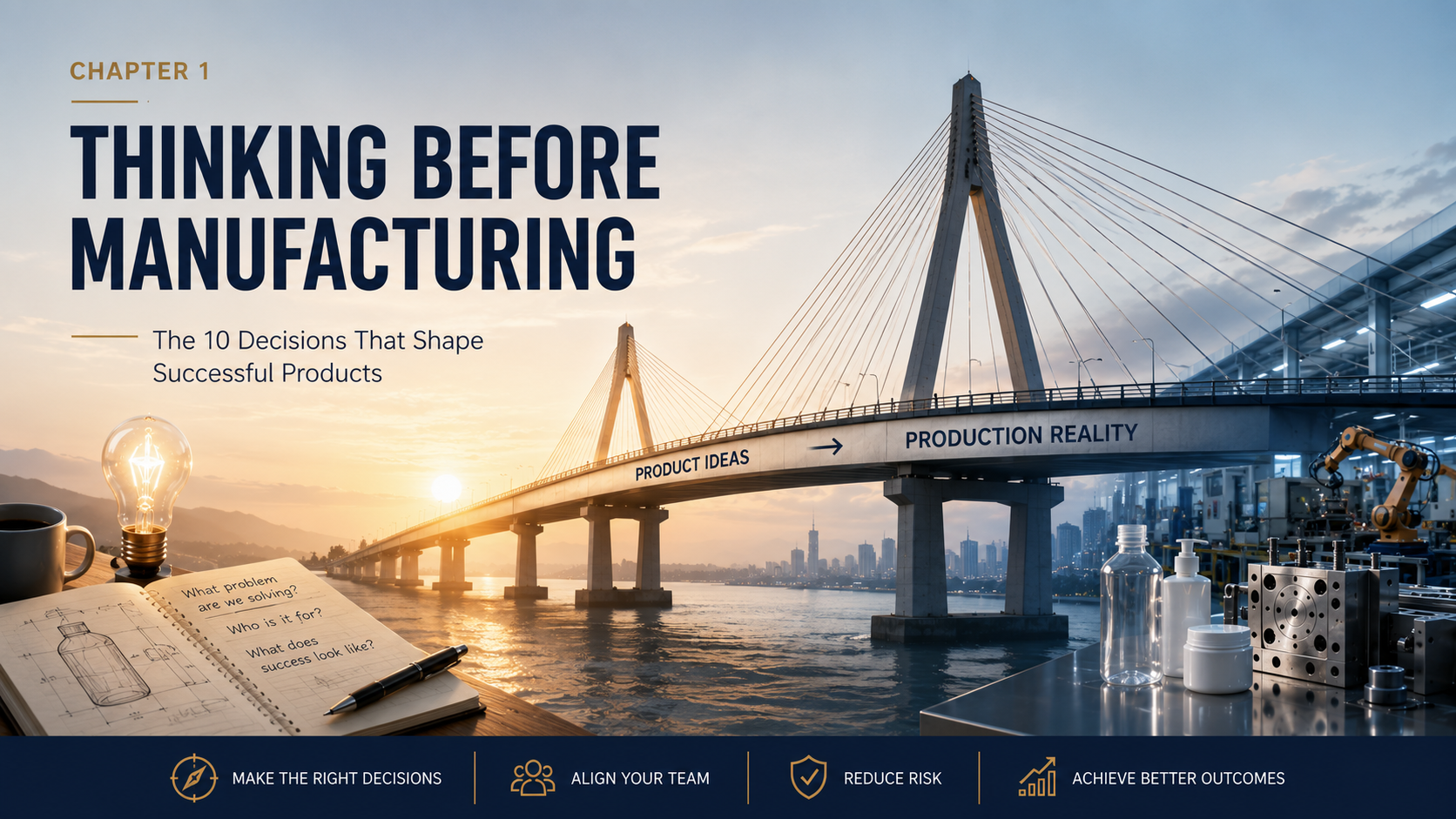
That is the bridge between an idea and a successful product.
If You Remember Only One Thing…
Every successful product is built twice.
The first time, it is built through decisions.
The second time, it is built through manufacturing.
The first determines the quality of the second.
If this chapter encourages you to pause before approving a quotation, investing in tooling, freezing a design or selecting a manufacturing partner, then it has already achieved its purpose.
Because the earlier an important question is asked, the less expensive the answer usually becomes.
Continue the Journey
This chapter introduced ten decisions that experienced teams naturally consider before committing to manufacturing.
Each deserves a deeper discussion.
Throughout the LoomTight Knowledge Library, we will explore these decisions individually—from manufacturing cost targets and tooling strategy to supplier selection, engineering changes, packaging development and project leadership.
Our goal is not to provide every answer.
Our goal is to help you think more clearly before making important product decisions.
Because companies often pay to learn these lessons.
We hope you won’t have to.
Download LT Framework 01
A printable reference version of the Product Realization Journey.